
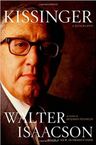
I would like to divide my review into three parts: my assessment of the book itself as a biography, my thoughts on Kissinger and my general comments on America.
This is a very interesting book since it is written by one of the most renowned Jew writers on maybe the most famous Jew bureaucrat in the history. I felt Walter Isaacson spent extreme effort to portray Kissinger as objective as possible. I have to admit that it is not easy to depict people like Kissinger who have complex personalities. Isaacson managed to achieve this difficult task at the expense of offending Kissinger. Walter gave extreme detail on the events which took place when Kissinger was at the White House. So, this book is an invaluable source in understanding the background stories of historical events such as Vietnam War, Invasion of Cambodia, The Yom Kippur War between Israel and Egypt/Syria, the shift in American policies toward Russia and China around 1970s. As far as the writing style I can say it is very fluid which is typical of Walter Isaacson, and it can be classified as a page-turner.
Let me talk about Kissinger little bit. Before reading the book, I guessed that he was smart, ambitious, authoritative, cold-blooded pragmatist and realist which turn out to be correct. But I also, don’t know why, thought of him to be a wise, mature, deep, philosophical, spiritual, and religious. I was way off. It was very surprising to learn that he was an unsecure, childish, quick tempered, manipulative, coward, flattering man who has no religious attachment and who only runs after low level ‘things’ such as power, women, fame, comfort, food. Let alone being religious, he also had no moral compass or ethical values. Lying, backbiting, deceiving was very normal to him when he was trying to reach his goals.
And finally, I want to touch upon American government. First thing you will notice in the book is how incoherent, incongruent the decision takers (President, Cabinet Members, State Department, Congress, CIA) in Washington are. Second, American foreign policies are not determined based on long term strategic viewpoints but based on short term personal whims, conflicts, goals, agendas of political players or local politics. Seems like we, non-Americans exaggerate American strategic planning and depth on geopolitical matters. Last, USA is more vulnerable than it seems. Its pristine, solid, strong image hides corruption, superficiality, lack of idealism and weakness. Now I can understand how and why USA failed in Iraq, Afghanistan, South America and other countries around the world.
In short, I highly recommend you reading this book if you are interested in politics and/or history.
·
336 Gösterim
Yorumlar
Lütfen giriş yapınız.