
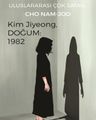
Choo Nam-joo’s novel Palsip Yi Nyeon Saeng Kim Jiyeong (better known in English as Kim Ji-young, Born 1982) is a deceptively simple yet profoundly impactful book. At first glance, it tells the life story of an ordinary Korean woman, Kim Jiyeong, tracing her experiences from childhood through adulthood. But as the narrative unfurls, it becomes clear that Ji-young’s life is far from “ordinary." It is a case study in the cumulative effects of everyday gender inequality.
The writing style is clear and direct, almost documentary-like, often presenting events with a clinical objectivity that makes the reader all the more aware of how “normal” discrimination can feel. We see Jiyeong repeatedly sidelined: in school when boys are prioritized and her concerns are dismissed; in the workplace through unequal pay, limited promotion opportunities, and subtle harassment; and later in domestic life where she is expected to sacrifice her career to become a full-time caregiver. These experiences are not presented as rare injustices, but as the everyday reality for many women, which is precisely the point.
One striking aspect of the novel is how it blends fictional life moments with real statistics and social commentary, sometimes through footnotes or contextual details that extend beyond Jiyeong’s personal story. This approach underlines how pervasive and normalized gender bias is. It’s not just one woman’s tragedy but a representation of structural inequality.
What makes the novel especially powerful is that it builds to something deeper than a recounting of wrongs: it reveals how systemic patriarchy distorts identity and self-worth. Jiyeong’s mental health deteriorates under the weight of internalized misogyny, cultural expectations, and relentless inequity, reminding the reader that gender inequality is not just a matter of policy or numbers, but of emotional and psychological consequence.
On Gender Inequality and the Novel’s Feminist Lens
At its heart, Kim Jiyeong, Born 1982 is a feminist critique of society. It shows how gender inequality is:
Cultural; women are expected to serve family before self, and boys are socialized as inherently more valuable.
Institutional; in jobs, labor is divided unevenly and women’s work is undervalued.
Psychological; cumulative bias wears on one’s sense of agency, leading to depression and identity loss.
The novel does not offer a neat resolution, which can be frustrating for readers, but this open-endedness reflects reality: gender inequality is not easily “fixed.” Instead, the story compels readers to confront how deeply patriarchal norms are woven into daily life and how these norms shape the possibilities available to women.
By grounding the narrative in the seemingly mundane, school lunches, office meetings, family roles, Cho Nam-joo illustrates how systemic sexism is reinforced through routine acts and omissions, not just dramatic events. This stylistic choice makes the book resonate far beyond South Korea; many readers around the globe have found Jiyeong’s experiences familiar, underscoring how gendered injustice is a global phenomenon.
·
42 Gösterim
Yorumlar
Lütfen giriş yapınız.