
SPOILER içerir...
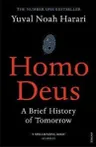
First, I wanna provide a brief summary of the book then I will share my comments on it:
Humans defeated famine, plague and war (starvation, epidemics and violence)
Humanities new targets are immortality, happiness and divinity by using artificial intelligence, big data, biotechnology, genetic engineering, regenerative medicine and nanotechnology and thus upgrading Homo Sapiens to Homo Deus.
Imminent dangers are climate change, global warming, pollution
Humans domesticated more than 90% of all large animals and thus conquered the world.
But humans are no different than animals since we have no soul, consciousness, mind or free will. Our sensations, emotions, desires and thoughts are biochemical data processing algorithms
What makes humans more special than animals are not our soul, mind or consciousness but our ability to cooperate flexibly in large numbers by creating ‘fictional myths’ such as money, corporation, state, gods. Fictions enable us to cooperate better and without fiction no complex human society can function.
Scientists study how the world functions, but there is no scientific method for determining how humans ought to behave. So, countries cannot function on the basis of scientific theories alone. They require some religion or ideology to maintain order.
Humanism (the worship of humankind which sanctifies life, happiness and power of Homo Sapiens) became the dominant world religion for the last 300 years.
Humanism split into three main branches, all of which believe that human experience is the supreme source of authority and meaning, yet they interpret human experience in different ways: Orthodox Humanism (Liberal humanism or simply as liberalism), Socialist Humanism (Communism, leftists), Evolutionary Humanism (Racism, Fascism such as Nazis, rightists).
Liberals think that the human experience is an individual phenomenon. Socialists value experience of whole society. Evolutionist value experience of superior humans.
After deadliest wars in 20th century between these differing views, liberalism (liberal humanism = individualism, human rights, democracy, and the free market) won and in 2016 it has no viable alternative
Humanism is doomed to fail in the future since humans have no free-will and human desires, emotions can be designed, controlled by new technologies, drugs, genetic engineering or direct brain simulation.
My Comments:
I like Yuval’s books mainly for two reasons:
1- His rich imagination. On a given subject, he can really brainstorm very creatively. He also has his own unique way of reading historical events which I find interesting.
2- He makes me question all the values/ideas that I accept since I was born. This is good because being provoked and stimulated this way forces you to either change your wrong view or strengthen your existing view.
Having said these, I have to mention that I don’t agree with almost all of Yuval’s claims and conclusions.
Mainly, he argues that humans are just another breed of animals, we have no soul, no free will, no consciousness. In fact we are just like robots. All of our actions are results of deterministic algorithms.
These are very bold claims and they need strong evidence. But Yuval can’t provide them. He just uses some scientific “theories/studies” as generally accepted scientific realities.
Just to give an example, it is mentioned on page 107 that “Most-up-to-date theories maintain that sensations and emotions are biochemical data processing algorithms”. Here it is clearly mentioned that this is just a theory. Also, on page 108 he accepts that “To be frank, science knows surprisingly little about mind and consciousness”. But then throughout the book Yuval uses this theory as a proved scientific reality and in fact use it as a basis for his whole book. So how credible is this methodology?
Another problem is his weak arguments. For example, regarding that there is no such thing as soul, he says that:
“That’s why the theory of evolution cannot accept the idea of souls, at least if by ‘soul’ we mean something indivisible, immutable and potentially eternal. Such an entity cannot possibly result from a step-by-step evolution. Natural selection could produce a human eye, because the eye has parts. But the soul has no parts. If the Sapiens soul evolved step by step from the Erectus soul, what exactly were these steps? Is there some part of the soul that is more developed in Sapiens than in Erectus? But the soul has no parts.”
This explanation ignores the fact that there may be metaphysical things in the universe such as soul which may not be a product of evolution. His implicit assumption is that everything in the universe is material, made up of atoms as a product of evolution. He considers soul as a material thing and thus gives this line of ludicrous explanation. And if you ask Yuval why he does not believe in metaphysical things, his answer would be you can’t detect those stuff in the laboratory. Well, you could not see many stuff in the laboratory until the last 100 years. Maybe your technology is not developed enough. Or maybe you cant’ detect metaphysical stuff in the laboratory at all since they are not made out of atoms. Long story short, this kind of weak arguments cannot and should not be used as if they are hardcore truths.
Somebody also should ask Harari that how can a human being with no soul, consciousness and free will write a book like yours? Is this an output of random electronic signals in your brain? So, how can we call you the author of this book then? What makes your output different than somebody else's output?
Another important point about the book is Harari uses past abuses of humanity or superstitions to substantiate that we have been deceived throughout the history all the time which implicitly forces the reader lose faith in any system, idea, religion that he/she believes in. This is by far the leading book that makes me feel worthless. I am a byproduct of blind forces of nature living in a world with no meaning at all. Any idea, belief system that I believe in is artificially created by mankind and has no intrinsic value.
Finally, the whole book hinges on atheism and evolution. But he never explains the source and origin of universe. How did something come into existence out of nothing? Especially this something is resting on a very delicate balance with all the great artful creatures in it. His use of “evolution” is as “behind the curtain great master mind” making every living creature to improve perpetually. What is this great mind then? Who created it? Is it itself the creator? If yes, why don’t we call it God then? If no, then who created it? Why are there natural laws in the universe? How can you explain the existence of these natural laws, including evolution, given that all the subatomic particles are moving around haphazardly per quantum theory? How come an order come into existence out of these random moving particles?
If I sum it up, good book to stimulate your mind, but full of weak, unsupported, unexplained arguments, sometimes warped scientific researches.
·
221 Gösterim
1 Yorum
Lütfen giriş yapınız.
