Unauthorized Existence·86 syf.·

10/10
2026 5. kitabı
The Hour of the Star is not a novel. It is an autopsy. Not of a life, but of a condition. Nothing “happens” because nothing is allowed to happen. Lispector dissects a form of existence that never rises to the level of experience. Poverty here is not dramatic, loneliness not lyrical. They are simply the baseline. Feeling itself is rationed.
The scream in this book is not rebellion.
“Because there’s the right to scream. So I scream.”
This is not a claim to freedom; it is a biological reflex. Proof of respiration, not resistance. A sound made to confirm that the body has not yet stopped functioning. No one is meant to hear it. No one is expected to respond.
Existence is not illogical because it is complex, but because it is arbitrary. Life is not organized around meaning, justice, or growth. Those are postures available only from a safe distance. Inside The Hour of the Star, life is reduced to maintenance. One continues not out of hope, but out of inertia. Endurance replaces desire.
What Lispector annihilates most effectively is the idea that suffering is universal. It is not. Even suffering has an entry fee. Sadness requires leisure. Grief requires space. Reflection requires a margin of safety. Here, there is no margin. Life must be executed, daily, efficiently. The subject performs “being” the way one performs labor.
The self is not fractured — it is undeveloped. The character does not mourn her lost identity because there was never an identity to lose. The absence inside her is not a wound; it is a vacancy. Awareness arrives late, and it arrives useless. Recognition does not repair damage. It only confirms it.
“So young and already rusted.”
This is not metaphorical. Corrosion precedes time. Exposure does the work faster than years ever could. The damage is not

It sounds strange however contrary to popular belief, rate of all kind of violence, death toles in wars, homicide rates, beating of children and woman, cruelity to animals and goes so on, declines throughout history. In this book, Steven Pinker uses a lot of numerical data and scientific research, papers to demonstrate that fact.
The book consists of 10 sections. The first six sections are about history and history of violence. We see a lot of data about that violence is really declined course of history. Also, Pinker explains political theories and ideas that influenced the revolutions that declined violence.
Sections 7 to 9 are about the psychology of violence and passivism. We see the affective neuroscience theory of the brain created by  Jaak Panksepp (
  Afektif Nörobilim ). This is the part that is related to our nature. We see brain systems related to violence and how to affect or suppress them. Also, as an evolutionary psychologist, Pinker explains some nature-nurture facts about the psychology of violence.
It's a really big book (For me, it took 2 big months of tons of reading) about the subject. Although books' length, Pinker is very successful in writing clear and incredibly fluent texts.
Unfortunately, I can not mention the content of the book here. I have dozens of pages of notes for this book. If someone curious about it can send me a private message to get them :).
Afektif Nörobilim ). This is the part that is related to our nature. We see brain systems related to violence and how to affect or suppress them. Also, as an evolutionary psychologist, Pinker explains some nature-nurture facts about the psychology of violence.
It's a really big book (For me, it took 2 big months of tons of reading) about the subject. Although books' length, Pinker is very successful in writing clear and incredibly fluent texts.
Unfortunately, I can not mention the content of the book here. I have dozens of pages of notes for this book. If someone curious about it can send me a private message to get them :).
Jaak Panksepp ( Afektif Nörobilim ). This is the part that is related to our nature. We see brain systems related to violence and how to affect or suppress them. Also, as an evolutionary psychologist, Pinker explains some nature-nurture facts about the psychology of violence.
It's a really big book (For me, it took 2 big months of tons of reading) about the subject. Although books' length, Pinker is very successful in writing clear and incredibly fluent texts.
Unfortunately, I can not mention the content of the book here. I have dozens of pages of notes for this book. If someone curious about it can send me a private message to get them :).
Reklam
reading the blind owl from perspective of nietzsche

Puan vermedi
Sadeq Hedayat is one of my favorite author in the literary world. The Blind Owl that introduced me to Sadeq Hedayat many years ago and it has entered my list of the best. Hedayat's masterpiece The Blind Owl attracted me with the very first lines, and caused me to experience a kind of hysteria with the last page of the book.
Coming to the content of the book; the hero is a heavily depressed man who earn his income with the paintings. He takes alcohol and opium continuously to make himself numb and stop thinking. One day as he walks to the kitchen to deliver wine to his uncle, he sees the elderly man and the stunningly beautiful girl through a hole in his wall, which causes his lonely existence to change. After this sight, he begins to think her all day hysterically. One night, he finds her waiting at the door of his home. After this strange encounter, he searches for anything to offer her then goes to get a bottle of wine for her. When he brings the wine, he thinks that the girl is asleep, and drops a sip in her mouth. He did, however, realize that she had passed away.He wants to ignore the cold of death with the warmth of his body, but later on realizes that it's not working. Then, he henhe decides to bury the girl by dismembering her and packing her pieces into a suitcase since he thinks she has given up on life and given her soul to him. The old man he saw with the girl, the carriage driver who came to pick her up, his uncle who came to visit, and even himself in some parts of the book, are actually all the same person transformed according to his descriptions. All the characters transform into each other and repeat themselves like eternal recurrence, creating a metaphoric effect. Always different faces, but same suffering.
According to

SPOILER içerir...
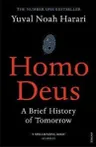
First, I wanna provide a brief summary of the book then I will share my comments on it:
Humans defeated famine, plague and war (starvation, epidemics and violence)
Humanities new targets are immortality, happiness and divinity by using artificial intelligence, big data, biotechnology, genetic engineering, regenerative medicine and nanotechnology and thus upgrading Homo Sapiens to Homo Deus.
Imminent dangers are climate change, global warming, pollution
Humans domesticated more than 90% of all large animals and thus conquered the world.
But humans are no different than animals since we have no soul, consciousness, mind or free will. Our sensations, emotions, desires and thoughts are biochemical data processing algorithms
What makes humans more special than animals are not our soul, mind or consciousness but our ability to cooperate flexibly in large numbers by creating ‘fictional myths’ such as money, corporation, state, gods. Fictions enable us to cooperate better and without fiction no complex human society can function.
Scientists study how the world functions, but there is no scientific method for determining how humans ought to behave. So, countries cannot function on the basis of scientific theories alone. They require some religion or ideology to maintain order.
Humanism (the worship of humankind which sanctifies life, happiness and power of Homo Sapiens) became the dominant world religion for the last 300 years.
Humanism split into three main branches, all of which believe that human experience is the supreme source of authority and meaning, yet they interpret human experience in different ways: Orthodox Humanism (Liberal humanism or simply as liberalism), Socialist Humanism (Communism, leftists), Evolutionary Humanism (Racism, Fascism